

Sacraments
Toda la vida litúrgica de la Iglesia gira en torno al Sacrificio Eucarístico y los sacramentos. En la Iglesia hay siete sacramentos: Bautismo, Confirmación, Eucaristía, Penitencia, Unción de los enfermos, Orden sacerdotal y Matrimonio. Los sacramentos, como "fuerzas que brotan" del Cuerpo de Cristo, son "las obras maestras de Dios" en la nueva y eterna Alianza. - CIC

Baptism
The Sacrament of Baptism marks the welcome of a new member into the Catholic Church. It is the gateway to Christian life and the foundation of all the other Sacraments. For this reason, both the parents’ preparation and the celebration of Baptism itself deserve special attention.
Baptisms are generally celebrated on the third Saturday of each month, after parents and godparents have completed the three required preparation classes and participated in the final rehearsal with the child.
The classes and the rehearsal take place on Monday evenings.
Requirements
2
1
Child's Birth Certificate
Sponsors (two options):
-
A married couple (married in the Catholic Church): A copy of the Catholic marriage certificate is required.
-
A single sponsor: This person must be in good standing with the Catholic Church, meaning they actively practice their faith and are able to receive Holy Communion. A Confirmation certificate is required.
3
Once you have the required information and certificates, please call or visit the office to complete your registration in person. The registration fee is $50.00.
4
Once the registration for Baptism has been completed, parents and sponsors must attend three baptismal prep classes and a rehearsal, in which parents, sponsors and children participate.
-
The baptismal classes take place on Mondays at 7:00pm in San Esteban.
-
The final rehearsal will take place on the campus where the Baptism will be celebrated at 7pm.
Please check the calendar for more information and specific dates.
-
For a calendar of available dates, click on the following link:
-
If you are looking for information about Baptism for children over 7 years old or for adults, please click here:
-
Online Registration:
Eucharist
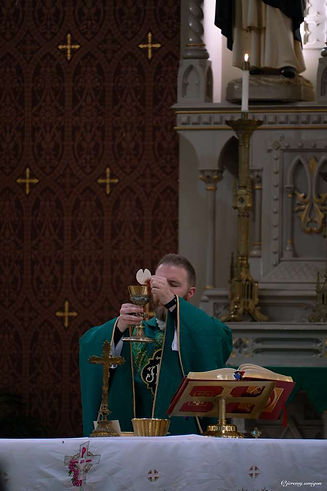
The Eucharist is one of the Sacraments of Initiation, received after Baptism and before Confirmation. In this Sacrament, Jesus gives Himself to us as spiritual nourishment, strengthening our faith and keeping us united to Him and to the community.
Each time we participate in Holy Mass, we remember and celebrate the immense love of Christ, who remains with us under the appearances of bread and wine. When we receive Holy Communion, Jesus enters our hearts and invites us to live as He did—with love, gratitude, and service to others.
The Eucharist is therefore the source and summit of our Christian life: the moment when we encounter the Lord in a deep and living way, and learn to recognize Him in our brothers and sisters as well.
MASS INFORMATION
If you are ill and unable to attend Mass and would like someone to bring the Eucharist to your home:
For information regarding the First Communion for children (under 18 years old).
For information regarding First Communion, of an adult (over 18 years old).
Does it have any in

Confirmation
Confirmation perfects Baptismal grace; it is the sacrament that gives the Holy Spirit in order to root us more deeply in our divine sonship, unite us more firmly to Christ, strengthen our bond with the Church, associate us more closely with her mission, and help us bear witness to the Christian faith in words accompanied by deeds.
— CCC 1318
For information on Sacramental prep for Confirmation
For information about confirmation of an adult
Reconciliation
The Sacrament of Reconciliation—also called Penance, Confession, Forgiveness, or Conversion—is the means by which Christ offers His mercy to the baptized who have fallen into sin. This sacrament responds to the ongoing need for conversion in the Christian life. Penance flows from a contrite heart moved by grace and is expressed through practices such as fasting, prayer, and almsgiving.
To receive this sacrament, the penitent carries out several essential acts:
-
An examination of conscience
-
Contrition—sorrow for sins
-
The confession of sins—especially serious sins, which must be confessed at least once a year
-
Satisfaction, or doing the assigned penance
The priest, minister of reconciliation, grants absolution in the name of the Most Holy Trinity.
The fruits of the sacrament include the forgiveness of sins, reconciliation with God and the Church, inner peace, and renewed spiritual strength.
Confession Times
Guide to Confession in English
Video about the Sacrament (Spanish)
Confession Guide in Spanish
Does it have any in


Anointing of the Sick
The Sacrament of the Anointing of the Sick is Christ's gift to accompany and strengthen those who are suffering from serious illness or the weariness of old age. Jesus showed profound compassion for the sick, and through his Passion he gave new meaning to suffering, which, united with his own, can be a path to hope.
The Church continues this mission by anointing the sick with blessed oil and praying for them. This sacrament offers peace, strength, union with Christ, forgiveness of sins, and, God willing, even physical health. When a person is about to depart to meet the Father, they receive Viaticum, the last Communion that prepares them for eternal life.
Do you or someone in your family need it?
Contact the parish office or call the emergency number
Do you need a priest at the hospital?
If you are unable to contact the parish and you are in the hospital, every hospital has a Catholic chaplain available. Simply let the nurse know that you need a priest, and they will contact the chaplain so they can visit you and administer the sacrament.
Holy Orders
The Sacrament of Holy Orders is the gift through which the mission entrusted by Christ to the Apostles continues in the Church. Through a special consecration, the Holy Spirit configures and sends bishops, priests, and deacons to serve the People of God in the name of Christ. Prefigured in the Old Testament and fulfilled in Jesus, Holy Orders shares in the one priesthood of Christ and makes present His work of teaching, sanctifying, and shepherding the faithful.
Holy Orders is conferred through the laying on of hands by the bishop and a consecratory prayer, which bestows a special grace and an indelible spiritual character. Bishops receive the fullness of the sacrament; priests are configured to Christ the Head and celebrate the sacraments, especially the Eucharist; and deacons are ordained for service in the Word, liturgy, and charity. Only baptized men can receive this sacrament, and in the Latin Church, the priesthood is ordinarily conferred on men who embrace celibacy for the sake of the Kingdom.
Ordination is conferred by the laying on of hands by the bishop and a consecratory prayer that bestows a special grace and a permanent spiritual character. Bishops receive the fullness of Holy Orders; priests are configured to Christ the Head and celebrate the sacraments, especially the Eucharist; and deacons are ordained to the service of the Word, worship, and charity. Only baptized men can receive this sacrament, and in the Latin Church, the priesthood is ordinarily conferred on men called to celibacy for the sake of the Kingdom.
Conoces a alguien que este interesado? Llama a la oficina parroquial o con uno de los sacerdotes:
Does it have any in
Visit the Archdiocese's page on vocations:


Marriage
The Sacrament of Matrimony is the covenant by which a man and a woman give themselves to one another to form a communion of life and love according to God’s plan: “So they are no longer two, but one flesh” (Mt 19:6). This union, established from creation and raised by Christ to the dignity of a sacrament, is ordered toward the good of the spouses and the procreation and education of children. Although sin can threaten marital harmony, God offers His grace so that marriage may be lived with fidelity, unity, and indissolubility.
The celebration of marriage is a public act of the Church, centered on the spouses’ free consent, which creates a permanent bond confirmed by God Himself. Through this sacrament, husband and wife receive the grace to grow in holiness through family life. The Christian family, born of marriage, is called the domestic Church because it is the first place where faith, prayer, and charity are lived and nurtured.
The celebration of marriage is a public act of the Church, centered on the free consent of the spouses, which creates a permanent bond confirmed by God himself. This sacrament grants the spouses the grace to attain holiness in family life. The Church also accompanies complex situations: it regulates mixed marriages, recognizes the possibility of physical separation when necessary, and offers pastoral care to divorced and remarried Catholics, even if they are unable to receive the sacraments. The Christian family, the fruit of marriage, is called the domestic church because it is the primary place where faith, prayer, and charity are lived out.
-
Call the office at least 9 months before the wedding
-
Premarital classes are necessary
-
Classes usually take place on Sunday mornings.
-
-
Call the parish office for more information
Sacramental Records
Sacramental records are released only to:
-
The person who received the sacrament, or
-
The parent(s) or legal guardian(s), if the person is a minor.
If an adult needs the sacramental record of their adult son or daughter, the son or daughter must complete the request personally. In these cases, the parish office will contact the individual to obtain verbal authorization.
Sacramental records are not provided for family history use or for genealogical purposes. If you are seeking genealogical information, please contact the Archdiocese for additional assistance.
To request your sacramental record, please call the parish office. You may also complete the form below if you prefer. The office will contact you if additional information is needed.
Note: If you are looking for a record of St. Stephen from 1998 to 2007, made by Father Lorenzo (Fr. Lawrence Hubbard), call The Church of the Incarnation; they will have the records from those years.